News • August 1, 2026
How Professional Associations Use AI Matchmaking Software to Increase Member Engagement
Member engagement is the #1 challenge facing associations today. See how AI matchmaking software fixes it, and how one global community tripled engagement.
By Kair Mourtazov, SmartMatchApp Product Specialist
Reading time: ~6 minutes
TL;DR
Professional associations and member organizations consistently name engagement and retention as their top challenge. AI matchmaking software closes that gap — turning static member directories into structured, ongoing introductions. Lead and Empower Her SHE Talks, a global women's community running events across four countries, replaced slow manual introductions with a weekly automated matching ritual and reports a 3x increase in engagement as a result.
The Member Engagement Problem, in One Stat
Retention and engagement are the top challenges facing associations today — cited by nearly a third of respondents in ASAE's inaugural State of Associations report (March 2026), the most comprehensive data-driven snapshot of the sector to date. The pattern is consistent with years of prior data: membership doesn't decline because people stop valuing community. It declines because they stop feeling connected to it.
That applies just as much to alumni networks, business chambers, and professional societies as it does to formal trade associations — any organization whose core value depends on connecting members to each other, not just delivering content or hosting events.
That's a matching problem, not a marketing one. Member organizations already have the data — profiles, interests, goals. What they lack is a system that turns it into introductions members actually act on.
From Directory to Matching Engine
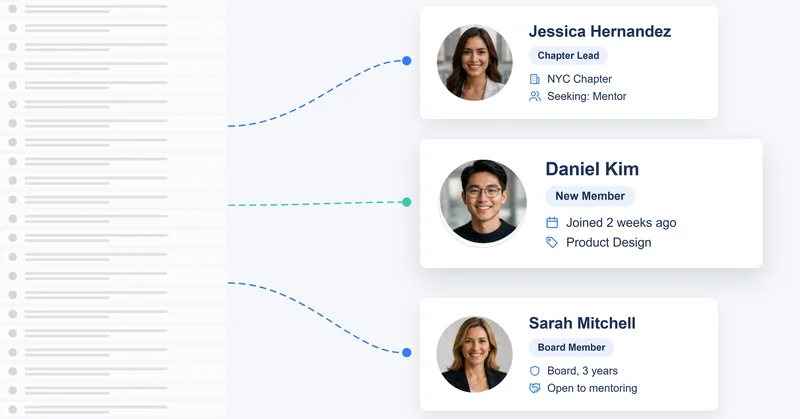
We covered the mechanics of this in detail in our guide to AI matchmaking software — structured data, compatibility scoring, automated introductions, and a feedback loop that improves over time. For associations and member organizations, the shift that matters most is simple: members stop scanning a directory of a thousand names and start receiving a short, ranked list of people worth actually meeting. That holds whether the organization calls itself an association, a chamber, a guild, or just a community — the constraint is the same. Staff can introduce dozens of members by hand. Not thousands.
Case Study: Lead and Empower Her SHE Talks
Dr. Julie Ducharme has built five businesses over a 20-year entrepreneurial career. Her best-known venture, Lead and Empower Her SHE Talks, started as a local networking group for women and has grown into a global member community with events across the US, Canada, Ireland, and the UK — a membership spanning women in their thirties through their seventies, plus a separate youth ambassador track, and roughly 70% entrepreneurs, from first-time founders to those who've sold multi-million-dollar companies.

The problem: growth outpaced manual introductions
Before SmartMatchApp, connections happened the way they do in most growing member organizations: manually. A member would ask for an introduction, and staff would try to recall a fit and connect them by email — a process that couldn't scale past a few hundred members, let alone thousands. Generic platforms didn't solve it either:
"A few other platforms weren't working. It wasn't creating that space for them, and the platform would have a thousand names on it. They didn't know who to connect with, or what they did, or how to connect."
Facebook groups had a different problem — members didn't want to mix a professional community with a personal feed. What SHE Talks needed wasn't more places to talk. It needed a way to turn a list of thousands into a short set of relevant introductions.
The fix: a weekly matching ritual
SmartMatchApp gave the community a structured alternative. Members build a profile — photos, videos, a short bio — and every Monday, they're prompted to check their suggested matches:
"We picked Monday and we call it Matching Monday. Every Monday, women are supposed to go in, they set their calendar for a 10-minute reminder, and they go in and they check their matches and their suggestions."
This solves more than one problem. Members see who they're matched with — photos, background, shared interests — before reaching out, replacing a flat directory with something navigable. It also lowers the barrier for members hesitant to approach someone first: the platform surfaces the match and gives them a reason to say hello instead of cold-messaging a stranger. Ducharme said this mattered most for shyer members — "it gives them a reason to go, 'hey, I see we're connected, or I see it's a suggested match.'"
That tracks with a broader pattern in the research. A 2024 Academy of Management Journal study, covered in Harvard Business Review, found that women who build strong relationships mixing peers and high-status contacts are 2.5 times more likely to secure a promotion — gains that come specifically through structured, intentional networks, not passive ones. Removing the friction of "who reaches out first" isn't a minor UX detail here — it's addressing the exact barrier the research identifies.
For a global, always-traveling membership, location data adds a second layer: members can see who's nearby, or who's traveling to wherever they happen to be. "Women can go in, they can look up where other women are... and message them and say, 'hey, do you want to all get together for a coffee?'"
Why it mattered at scale
The constraint Ducharme kept returning to was headcount, not intent: a fast-growing global organization doesn't have enough staff hours to introduce members one email at a time. "There's not enough people to single-handedly email each other and do all of that. And emails get lost, too." Automating the matching layer lets the community keep growing without losing what she calls the "personal side" as it scales.
SHE Talks reports a 3x increase in engagement since implementing structured matching — reflecting both the volume of introductions made and their relevance. That matters most in context: the organization began with a single event of roughly 100 women and now runs an active 10K Women Rising initiative aiming to reach and empower over 10,000 women through mentorship, training, and community. Matching is now a documented part of the membership itself — the member portal lists AI matching tools alongside the member directory as a core benefit, and SHE Talks runs its own branded member portal on the platform.
The use case has since expanded beyond weekly matching. SHE Talks now sells tickets to public speed matching sessions — open to members and non-members alike — where attendees are matched to relevant counterparts rather than left to work a room. Structured matching moved from an internal membership perk to a revenue-generating event format.
That's the shift worth noting for any association weighing this: introductions stopped being a service the staff performed and became infrastructure the membership runs on.
Lead and Empower Her SHE Talks at a glance
|
Engagement |
3x increase - introduction volume and relevance |
|
Countries with active events |
4 (US, Canada, Ireland, UK) |
|
Events per year |
12+ (roughly one per month) |
|
Entrepreneurs in community |
~70% |
|
Current initiative |
10K Women Rising - reaching 10,000+ women |
|
Also runs on the platform |
Public speed matching / networking sessions |
A Different Angle: Blacks in Technology Foundation
Blacks in Technology Foundation — the largest professional community for Black technologists in the industry — used SmartMatchApp to solve a different problem than SHE Talks did. SHE Talks needed member-to-member matching; BIT's more pressing gap was staff-side visibility across a decentralized, multi-chapter organization. Before centralized tooling, Executive Director Dennis Schultz had no single view into chapter activity: "There was no centralized management for me... to see all of the chapter events going on at any given time." A centralized calendar changed that — chapter events, RSVPs, and member overlap became visible from one dashboard, making it easy to see which chapters were active and which needed a nudge.
Dynamic member mapping added a second layer — a real-time view of where members were located globally, shaping how chapters planned events. BIT's formal mentorship program, Converge, paired members into six-month, one-to-one cohorts, a model that gets difficult to coordinate by hand once a member organization reaches thousands of people.
For associations built on a chapter or regional-office model — trade groups, alumni networks, franchised nonprofits — this is often the more urgent problem before member-matching even comes into play: not "how do we connect members," but "how do we see what our own organization is doing."

What to Look For When Evaluating Matchmaking Software
Most platforms in this category describe themselves in nearly identical terms — AI matching, smart suggestions, member profiles. The differences only show up in how they handle five things. These are the questions worth asking on a demo call, whichever vendor you're evaluating.
Does it capture intent, or just profile data? Name, title, and company tell you what someone does, not why they joined or who they need to meet. Shallow inputs produce shallow matches, regardless of how good the algorithm claims to be. Ask what fields the platform can capture and whether you can define your own.
Will members actually adopt it? Low adoption is what quietly kills most member-matching initiatives — a capable platform nobody logs into delivers nothing. Ask how long profile setup takes and whether members need training to use it.
Does it prioritize relevance over volume? A long list of weak matches creates the appearance of engagement without the substance. Fewer, better-ranked introductions consistently outperform more introductions. Ask how candidates are ranked and whether you can weigh the criteria that matter to your community.
Does it work outside of events? Event-only matchmaking tools go quiet for 11 months of the year. For member organizations, the value is in year-round connection — mentorship pairings, new-member onboarding, ongoing peer introductions — not just conference week.
Can you measure whether it worked? Logins and match counts are activity metrics, not outcome metrics. Ask whether the platform collects post-introduction feedback, and whether that feedback loops back into future matching.
FAQs
What is AI matchmaking software for professional associations and member organizations? It's a platform that connects members based on structured profile data — interests, expertise, goals — rather than a static directory. It ranks potential connections by compatibility and automates the introduction, so members don't have to search a member list to find someone worth meeting.
How does matchmaking software increase member engagement? It replaces manual, staff-driven introductions with automated ones members receive on a regular cadence. Relevant introductions get acted on more often than random ones, and participation — not just membership — is what drives renewal.
What's the difference between a member directory and matchmaking software? A directory is a searchable list. Matchmaking software is an active recommendation layer on top of that same data — instead of scrolling thousands of profiles, members get a short, ranked set of introductions already identified as relevant.
What types of member organizations use matchmaking software? Trade associations, professional societies, alumni networks, commerce chambers, and non-profit communities all use it for the same reason: their value depends on connecting members to each other, not just delivering content or hosting events.
What's the difference between event matchmaking and member matchmaking software? Event matchmaking connects attendees during a specific conference or trade show. Member matchmaking runs year-round across the full membership — onboarding introductions, mentorship pairings, and ongoing peer connections — so the platform keeps delivering value between events, not just during them.
What is "Matching Monday," and can other associations use it? It's the weekly ritual SHE Talks built around AI matchmaking — a short reminder for members to check new AI-suggested introductions. The cadence itself isn't proprietary: any association can set a recurring check-in, and it's often the single highest-leverage habit for turning a matching feature into real engagement.
The Bottom Line
Associations and member organizations aren't losing members because they lack content, events, or communication — most send more of all three than ever. They're losing members because the connections that create real value still happen manually, if at all. AI matchmaking software fixes the mechanism, not the message.
👉 Book a demo to see how it works for your community.