News • August 12, 2026
How Mentorship Programs Use AI Mentor Matching Software to Pair Mentors and Mentees
Mentors name scheduling a bigger obstacle than a bad fit. See what predicts a good mentor pairing — and how one nonprofit runs three programs from one intake.
By Kair Mourtazov, SmartMatchApp Product Specialist
Reading time: ~5 minutes
TL;DR
Mentor matching software pairs mentors and mentees using structured data — goals, interests, availability, field, experience — instead of a coordinator's memory and a spreadsheet. The difference is measurable: in the most rigorous meta-analysis of mentoring programs to date, programs that used participant interests to inform matching showed roughly double the effect on participant outcomes compared with those that didn't. PRISM, a Pittsburgh non-profit pairing international students and scholars with local mentors, replaced email threads and spreadsheets with a matching platform and now runs three distinct connection programs from a single intake.
What Is Mentor Matching Software?
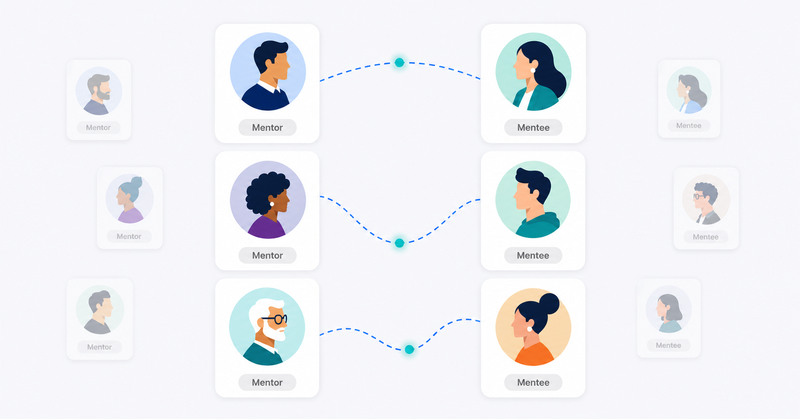
Mentor matching software is a platform that pairs mentors with mentees based on structured profile data — goals, interests, availability, location, field, and experience — then manages the introduction, tracking, and feedback that follow. It differs from a mentor directory in one respect that decides everything else: a directory is a searchable list that leaves participants to find each other, while matching software scores candidate pairings by compatibility and hands a short, ranked shortlist to a coordinator or participant.
Does Better Matching Actually Improve Outcomes?
Most mentorship programs run on a reasonable assumption: any mentor beats no mentor. The evidence however doesn't follow.
DuBois, Portillo, Rhodes, Silverthorn and Valentine's 2011 meta-analysis of 73 mentoring program evaluations, published in Psychological Science in the Public Interest, found that programs using participant interest information to inform matching produced an estimated effect size of .41 on participant outcomes, against .20 for programs where the practice wasn't evident. The difference was statistically significant, and interest-informed matching survived as a predictor even after controlling for other practices such as mentor training.
Two honest caveats, because most vendor content skips both.
That meta-analysis studied youth mentoring — programs pairing under-18s with adult volunteers. Whether the finding transfers cleanly to adult mentorship is a fair question. The best available answer comes from Eby, Allen, Evans, Ng and DuBois's 2008 multidisciplinary meta-analysis in the Journal of Vocational Behavior, which compared youth, academic, and workplace mentoring directly and found larger effect sizes for academic and workplace mentoring than for youth mentoring. If anything, evidence drawn from youth programs understates what's at stake in adult ones.
And the matching evidence itself is thinner than the headline number suggests. The National Mentoring Resource Center, which reviews mentoring practice for the U.S. Office of Juvenile Justice and Delinquency Prevention, rates the practice as having insufficient research overall: only eight of the 82 samples used interest-based matching, and two controlled studies isolating single characteristics — shared race, shared disability status — found no meaningful outcome difference.
The defensible conclusion is narrower than "match on interests," and more useful: matching on any single surface characteristic doesn't reliably work, and matching on nothing at all reliably underperforms.
What Actually Predicts a Good Mentor Match
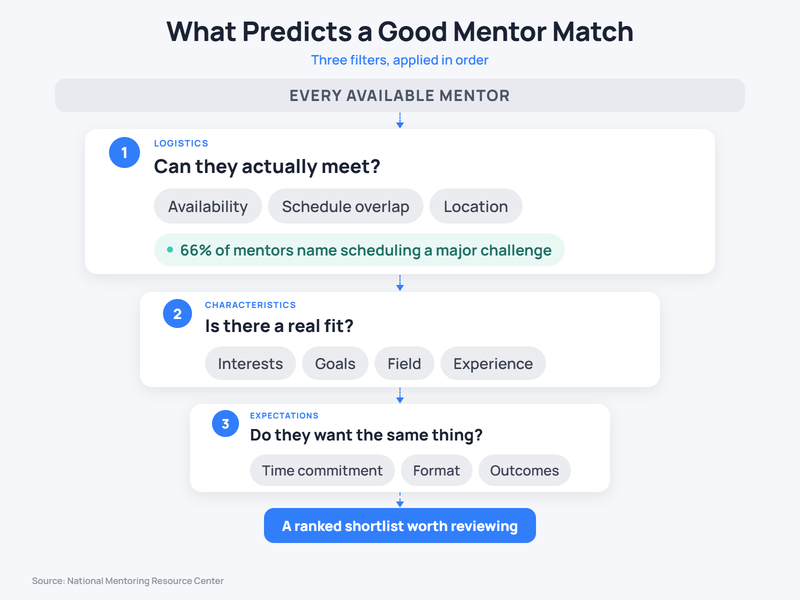
The most practical framework in the literature comes from the National Mentoring Resource Center's guidance to practitioners, which sorts matching inputs into three categories. Programs that over-rely on any one produce matches that struggle.
- Logistics — can these two people actually meet? Schedules and proximity get dismissed as admin detail. In the federally funded Role of Risk study cited in that review, 66% of mentors named their own schedule as a major challenge, and 48% cited logistical difficulty arranging meetings — both far ahead of the 28% reporting mismatched interests or personalities. A pair with everything in common who never find an hour is still a failed match.
- Characteristics — interests, goals, field, background, life experience. What most programs mean by "matching." It works as a combination, not as any single variable.
- Expectations — what each person thinks they signed up for. A recurring theme in research on failed matches is participants quitting because the experience diverged from what they expected.
The implication for buyers is direct: a platform capturing only characteristics automates the least reliable third of the problem. Structured matching earns its cost by letting you filter on logistics first, weight characteristics second, and capture expectations at intake — consistently, across a roster larger than one person can hold in their head. The mechanics are covered in our guide to AI matchmaking software.
Manual Matching vs. Mentor Matching Software
| Manual matching | Mentor matching software | |
|---|---|---|
| Basis | Coordinator's recall of participants | Structured intake data, scored and ranked |
| Logistics | Discovered after the pair tries to meet | Filtered before the match is proposed |
| Ceiling | The roster one person can remember | Limited by data quality, not memory |
| Consistency | Varies by coordinator and by week | Same criteria applied to every pairing |
| Multiple programs | A spreadsheet per program | One database, separate criteria per program |
| Outcomes | Anecdotal, retrospective | Post-match feedback that informs future matching |
| Staffing risk | Program knowledge leaves with the coordinator | Program logic lives in the system |
Case Study: How PRISM Matches Mentors in Pittsburgh
PRISM is a Pittsburgh non-profit serving international students and scholars — people arriving for research, master's degrees and PhDs, often with a spouse and children. It has served the region since the 1980s, with a staff you could seat around one table and a mission it describes as reaching the 13,000+ international students living in Pittsburgh.
Three programs, one intake
PRISM's matching runs under a single program brand, PRISM Connections, which offers students a choice of three relationship types:
| Connection type | Commitment | Focus |
|---|---|---|
| Friendship Partner | Ongoing | Local friendship, city life, culture |
| English Partner | 8 sessions | Conversational English practice |
| Mentorship | 8 sessions | Whole-person curriculum — self-awareness, work/life balance, goal-setting |
One intake, three genuinely different matching problems with different durations and criteria. PRISM's mentorship track is framed explicitly as addressing the whole person, not just workplace advancement — a different matching brief from a corporate mentoring program, and a good illustration of why fixed schemas fail here.
The program also publishes a cadence, which matters more than it looks: volunteers are asked to meet their partner at least once a month and check in weekly. Structured matching gets a pair started; a published rhythm is what keeps them going.
That distinction matters. Peer-reviewed research on international student networks finds these students tend to form friendships primarily with other international students rather than with local students, even when they would prefer cross-national friendships. The gap isn't desire. It's the absence of a mechanism.

The problem: spreadsheets, and a vendor that couldn't bend
PRISM matched people for years before it had software for it. In a 2022 interview with us, community manager David Lambacher described the legacy process bluntly: "endless emails," spreadsheets, and "communication ad nauseam."
Their first fix failed. PRISM researched the market, signed with another matchmaking platform, paid, and began implementation — then backed out. The blocker was rigidity: no customization, no way to change terminology or interface to fit how the organization actually worked. For a non-profit routing one intake into three different relationship types, fixed fields weren't a cosmetic complaint. Lambacher evaluated general-purpose CRMs too, Salesforce among them — the common pattern, since sales CRMs model deals rather than relationships between two people.
The fix: shortlist by algorithm, decide by hand
Volunteers and student-scholars complete essentially the same profile structure, then get matched into whichever connection type they chose. The engine shortlists; staff decide. PRISM still runs this way today — students are matched to a volunteer through the platform directly from the organization's own site.
Lambacher singled out that division of labor as the biggest change — the algorithm "takes a lot of the time out of having to figure out who is the best match for this student." Staff review ranked candidates and apply context the software lacks: a 95% match may already be paired, so they move to the next. That's the workflow that holds up in practice — ranked suggestions plus human judgment, not automated pairing.
The outcome: matching stopped being a committee
The clearest result wasn't a match rate. Matching went from a three-person job to a one-person job. Not because the work got less important — because the part that consumed the most hours, cross-referencing who might suit whom, stopped being done by hand.
Lambacher's advice to other community managers is worth hearing before anyone buys software to fix a strategy problem: clarify your purpose and vision first, because "the more you can clarify that," the better a tool like this works.
PRISM at a glance
| Organization | PRISM (Pittsburgh Region International Student Ministries), Pittsburgh PA |
|---|---|
| Serves | International students and scholars; 13,000+ in the Pittsburgh region |
| Operating since | 1980s |
| Matching workload | From a three-person job to a one-person job |
| Programs matched | 3 connection types under one intake — Friendship, English, Mentorship |
| Mentorship format | 8-session whole-person curriculum, one-to-one |
| Published cadence | Meet monthly, check in weekly |
| Previous system | Spreadsheets and email; one abandoned vendor contract |
| Deciding factor | Customization — fields, terminology, and interface |
What to Look For When Evaluating Mentorship Matching Software
Every platform in this space describes itself identically: AI matching, smart pairing, program analytics. The differences surface in five places.
Can you match on logistics, not just profiles? Given how heavily scheduling and proximity predict whether matches actually meet, availability and location need to be matching criteria, not notes fields.
Can you change the language and the fields? A university alumni program, a clinical preceptorship, and a community friendship program need different intake questions and different vocabulary. Rigid schemas are the most common reason programs abandon a platform they already paid for — as PRISM's first attempt shows.
Can one platform run more than one program? Most organizations running mentorship also run something adjacent — peer support, events, onboarding cohorts, alumni networking. If each needs its own tool, you've traded a spreadsheet problem for a licensing one.
Does it suggest, or does it decide? Auto-assignment sounds efficient and tends to produce matches nobody stands behind. Ranked suggestions a coordinator confirms preserve the human judgment the research supports.
Can you capture what happened next? Match counts are activity. Whether pairs met, how often, and whether it helped are outcomes. Ask whether post-match feedback loops back into future matching.
FAQs
How does mentor-mentee matching software decide who to pair? It scores candidate pairs against criteria the program defines and weights, then presents a ranked shortlist. In most well-run programs a coordinator makes the final call from that shortlist rather than accepting automatic assignment.
Does matching on shared interests actually improve mentoring outcomes? The evidence points that way but it isn't conclusive. DuBois et al.'s 2011 meta-analysis found roughly double the effect size for programs using interest-informed matching, though the National Mentoring Resource Center rates the overall evidence base as insufficient. What's clearer is that matching on a single characteristic in isolation shows no reliable effect, while weighing logistics, characteristics and expectations together is what practitioners are advised to do.
What's the difference between mentorship software and a mentor directory? A directory is a searchable list that puts the burden of finding someone on the participant. Matching software is a recommendation layer on the same data: participants receive a short, ranked set of pairings already identified as relevant, and coordinators manage the whole program from one place.
What is the best mentor matching software for nonprofits? There's no single best platform — fit depends on whether you can customize fields and terminology, run more than one program from one database, and match on availability as well as interests. Non-profits and community organizations typically need more flexible profile structures than enterprise mentoring tools allow, and less HR-system integration than those tools charge for.
Can the same platform run mentorship and other community programs? Yes, and for smaller organizations that's often the deciding factor. The same matching engine that pairs mentors and mentees can run peer support pairings, friendship or buddy programs, event networking, and alumni introductions — provided it supports separate profile structures and criteria per program.
The Bottom Line
Mentorship programs rarely fail for lack of willing participants. They fail because coordinators match from memory, pairs can't find a time to meet, and nobody learns a match went cold until the program ends. Mentor matching software doesn't supply the care or the curriculum — PRISM's coordinator would be first to say the relationship work is still the work. It supplies the mechanism underneath, so a program can grow past the limits of one person's attention.
👉 Book a demo to see how mentor matching works for your program.
