News • August 17, 2026
Business Matchmaking: How Networks Turn Introductions Into Deals (2026)
Most venture deals start with an introduction, not a cold pitch. See the five types of business matchmaking, and how two networks run it month after month.
By Kair Mourtazov, SmartMatchApp Product Specialist
Reading time: ~8 minutes
TL;DR
Business matchmaking identifies companies and professionals whose needs and offers complement each other (buyers and sellers, investors and startups, referral partners, collaborators, brands and creators) and introduces them with a reason to meet. It works because deals rarely start cold: in a survey of 885 venture capitalists, only 10% of deals arrived unsolicited from founders. This guide covers the five types of business matches, why follow-through matters more than the match itself, and two networks that run matchmaking year-round. The Match Lab made about 200 matches in its first monthly cycle. On GroupSocial, one brand's campaigns drew more than 100 creators in about a week.
What Is Business Matchmaking?
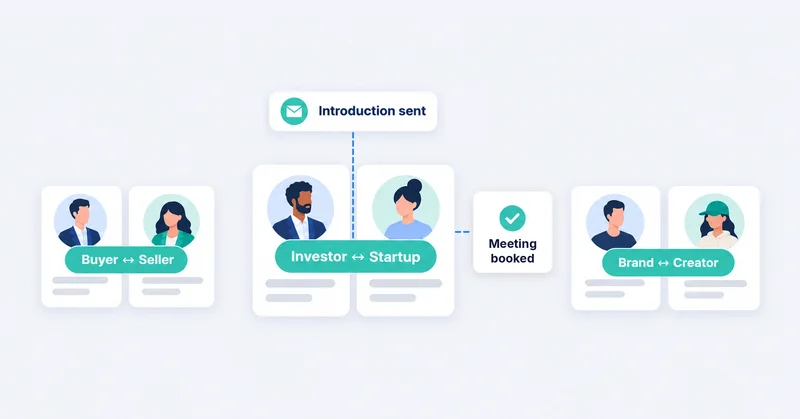
Business matchmaking is the structured process of identifying companies or professionals whose needs and offers complement each other, and introducing them with a stated reason to meet. A buyer who needs a supplier, a startup that needs capital, two consultants who serve the same clients without competing: matchmaking finds those pairs deliberately rather than waiting for them to meet by chance.
It differs from networking in one respect. Networking puts people in the same room, or the same feed, and leaves them to find each other. Matchmaking decides in advance who should meet and why.
Most coverage treats business matchmaking as an event format: pre-scheduled one-to-one B2B meetings at a trade show or conference, which our guide to event matchmaking software covers. This article is about the other model: networks, communities and platforms that match members continuously, with no event required.
Why Introductions Beat Cold Outreach
The strongest evidence comes from venture capital, where deal sourcing has been studied closely. Gompers, Gornall, Kaplan and Strebulaev surveyed 885 institutional venture capitalists at 681 firms, in a study later published in the Journal of Financial Economics. The median firm considered about 200 companies a year and closed around four deals. Those deals came from:
- Professional networks: about 31%
- Referrals from other investors: 20%
- Referrals from portfolio companies: 8%
- Unsolicited approaches from founders: only 10%
Most of the rest were sourced by the investors themselves. Few investments, the authors note, come from founders with no connection to the firm.
Buyers point the same way. In a Gartner survey of 632 B2B buyers, 73% said they actively avoid suppliers who send irrelevant outreach. A poorly targeted approach doesn't just underperform a relevant introduction. It can cost the supplier that buyer.
Neither study measures matchmaking programs directly. The venture data covers one industry, surveyed in 2015–16, and Gartner's figure reflects what buyers say rather than what they were observed doing. However, both point to the same constraint. The scarce resource in business isn't contacts. It's qualified attention, and a trusted introduction is how most of it gets allocated.
The Five Types of Business Matches
Business matchmaking covers at least five distinct matching problems. They share a mechanism (structured profiles, a matching engine, an introduction) but not the criteria.
| Match type | Who gets matched | Match on | What success looks like |
|---|---|---|---|
| Buyer–seller | Companies with a need ↔ suppliers or service providers | Need, category, budget range, location, timing | A qualified meeting that leads to a proposal |
| Investor–startup | Investors ↔ founders or funds raising capital | Thesis, stage, ticket size, sector, geography | A first meeting that leads to due diligence |
| Referral partner | Businesses serving the same clients without competing | Client overlap, complementary services, values | Referrals flowing in both directions |
| Collaborator | Businesses with complementary offers or audiences | Business stage, audience fit, capacity, working style | A co-created offer, event or piece of content |
| Brand–creator | Brands ↔ content creators | Platform, audience size, location, demographics, content category | Content published and audience reached |
The table hides a structural difference.
- Difference matching. Buyer–seller, investor–startup and brand–creator matches work this way: each side has what the other needs. Profiles have to capture both what a member offers and what they're looking for.
- Similarity matching. Referral and collaborator matches lean this way: the two businesses need to share a client base, a stage or a set of values.
Most networks run both, which means separate criteria for each. Our guide to AI matching criteria covers that setup. For how scoring and ranking work under the hood, see our guide to AI matchmaking software.
The Bottleneck Is Follow-Through, Not Matching
Ask people who run business matchmaking where it breaks, and the answer is rarely the match.
Robert Rubinstein, founder of impact-investing network TBLI Group, said as much in a 2022 interview with us. The matching was efficient; getting people to respond was the hard part. He once referred clients to a contact who claimed a 40,000-investor network and a team of analysts phoning every investor twice a year. The clients raised nothing. His conclusion: "it's not the process, it's the network you have." An introduction works when the person making it is trusted, and when someone makes sure it goes somewhere.
Destiny Dingle of The Match Lab hit the same gap in her first matching cycle: some members met straight away, while others asked what they were supposed to do next.
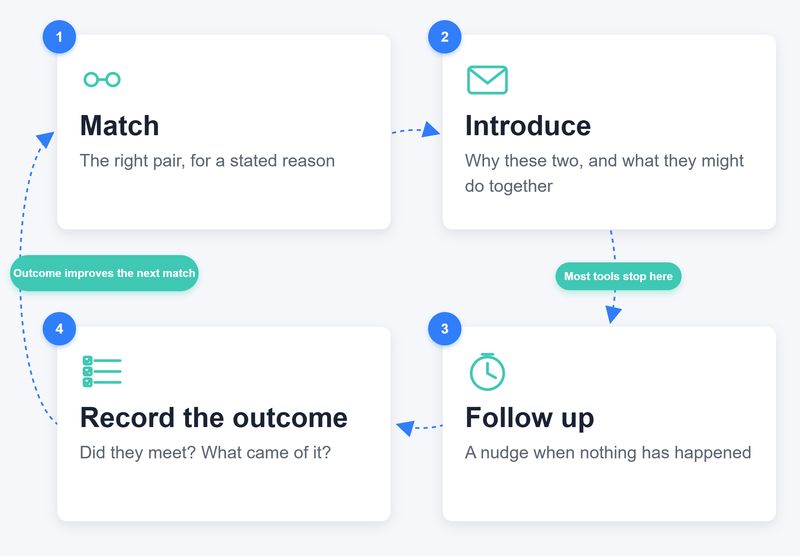
A business matchmaking program that holds up covers four stages. Most tools stop after the second.
- Match the right pair, for a stated reason.
- Introduce them with that reason: why these two, and what they might do together.
- Follow up when nothing has happened after an agreed interval.
- Record the outcome (whether they met, and what came of it) so the next round of matching improves.
Stages two to four can be largely automated, from branded introductions to reminders and feedback collection. Our guide to introductions and match automation shows how.
Manual Business Matchmaking vs. Matchmaking Software
| Manual matchmaking | Matchmaking software | |
|---|---|---|
| Who finds matches | A connector's memory and inbox | Structured profiles, scored and ranked |
| Ceiling | What one person can remember | Data quality, not memory |
| Match types | One at a time, informally | Several, each with its own criteria |
| Introductions | Written from scratch | Templated, with the reason for the match |
| Follow-up | Only if someone remembers | Scheduled reminders |
| Outcomes | Anecdotes | Recorded per match, informing future matching |
| Member self-service | None; every introduction goes through one person | Directory and connection requests alongside curated introductions |
| Key-person risk | The network leaves with the connector | The network stays in the system |
Case Study: The Match Lab
The Match Lab is a women-only network that matches online service providers (coaches, consultants, designers, marketers and other online service businesses) with the people who can help them grow. Founder Destiny Dingle runs it on SmartMatchApp.
The problem: networking that produced contacts, not clients
Destiny launched her own business in 2024 as a virtual assistant and rebranded in January 2025 as an online business manager, handling systems, automation and project management. Having quit her corporate job to go full-time, she spent the next seven months chasing clients through social media, networking events and coffee chats. She worked 60-hour weeks and still didn't land consistent work.
When she talked candidly with other women running online service businesses, she heard the same story behind even the most polished profiles: well-matched clients were hard to find through networking alone.
The build: a matching engine instead of a spreadsheet
Destiny's background is operations, and she ruled out makeshift tools from the start: "I will never do something to this capacity on an Excel sheet or another platform like HubSpot or Monday where it's not meant for it." She listed her requirements, with an in-app matching algorithm at the top, and chose SmartMatchApp. Configuring the community and its matching took a few weeks.
Her setup splits the work between curation and self-service:
- Curated matching. Matching runs on the back end once a month, and matches go out as mutual introductions.
- Member portal. All members get one. A premium tier adds sending and receiving match suggestions and browsing the full directory.
- Manual first. She started with manual introductions deliberately, planning to automate once the process was proven.
The first month also sharpened her intake. "Service provider" drew applications from product sellers and brick-and-mortar businesses, so she narrowed the brief to online service providers in fields such as writing, coaching, consulting, operations, design, tech, legal and marketing.
First cycle: four match types, about 200 matches
The first cycle ran in January 2026 and matched roughly 50 members. Each received four matches: a potential client, support provider, referral partner and collaborator, for about 200 matches in total. In the terms of the table above, that's buyer–seller matching in both directions plus referral and collaborator matching, all from a single intake.
Feedback split two ways:
- Matches that clicked. Some members met and reported that the pairing made obvious sense: "I get along with this person so well. It makes sense why it was a match." One found she already knew her match and had worked with her, which Destiny read as a sign the criteria were capturing something real.
- Members unsure what came next. Others asked about next steps, which is the follow-through gap described above.
Destiny also fixed a few rough edges traced to settings she hadn't yet configured.
Since the interview: fewer matches, more context
The Match Lab's published model has since changed. Its website now offers two hand-selected collaborator connections a month to women running five- and six-figure online service businesses.
- How matching works. It starts from a member questionnaire, and Destiny reviews each candidate's website and social profiles before introducing them.
- What each introduction includes. Match insights and collaboration ideas.
- After the introduction. Past matches receive follow-up emails.
- The member portal. It holds current and past matches, the directory, connection requests and messaging.
- Joining. New members join through a waitlist.
Set against the first cycle's feedback, two additions stand out: each introduction now suggests a next step, and each match gets a follow-up.

The Match Lab at a glance
| Organization | The Match Lab: women-only matchmaking network for online service providers |
| Founder & CEO | Destiny Dingle |
| First matching cycle | January 2026 |
| First-cycle volume | ~50 members, ~200 matches |
| Match types (Feb 2026) | Client, support provider, referral partner, collaborator |
| Current model | Two collaborator connections a month, with follow-ups |
| Matching method | Back-end matching, reviewed by hand, sent as mutual introductions |
| Member access | Portal with directory, connection requests and messaging |
| Ruled out | Spreadsheets and general-purpose tools like HubSpot and Monday |
Case Study: GroupSocial
GroupSocial is a matchmaking platform for the creator economy. Founder and CEO Andrew Dollamore describes it as a LinkedIn for creators: brands connect with creators, creators with brands, and each with their own kind. Unlike the other examples here, matchmaking isn't a service GroupSocial offers its members; it's the product. It runs on SmartMatchApp.
The problem: social platforms throttle the outreach brands need
Andrew came from web hosting, where he watched small businesses swap websites for social profiles. That shift left a gap on the marketing side. Social platforms cap how many direct messages and follows an account can send each day. In Andrew's view, the caps exist to push brands toward paid ads. Either way, a brand can't use Instagram or TikTok to find and approach creators at scale. Agencies can, at a price most small brands can't afford.
The build: a matching engine at consumer scale
Matching expertise was the first thing Andrew needed, and the hardest to find: "nobody goes to university to learn how to develop matching algorithms." After searching Google and LinkedIn, he chose SmartMatchApp. GroupSocial started on the standard platform. As its requirements grew, it moved to a dedicated custom environment with its own servers and interface, with SmartMatchApp supporting back-end and front-end development.
The matching engine is what lets GroupSocial keep an open door. Anyone can join, from a creator with 50 followers to a global brand, because each side's match settings decide what the other sees. A brand that doesn't want creators under 1,000 followers never sees them. As Andrew put it in 2025: "because of that matching algorithm, we can … be completely confident that when people sign up, each individual sees what they're looking for more often than not." Match filters do the job that gatekeeping does in most networks.
Growth came through the platform's own marketplace: every creator who joined was offered a collaboration to create content about GroupSocial. "If Group Social can't grow Group Social, then there's no point doing it," Andrew said. By April 2025, that approach had grown the platform organically to nearly 50,000 members.
How a brand launches a collaboration
- Target creators by platform and minimum audience size, then narrow by location, age, gender and content category. A live count shows how many creators match and their combined reach.
- Set the offer: cash, gift cards, gifted products or services, discounts, event invitations or an affiliate program.
- Set volume and messaging: how many creators to accept, plus an automatic message sent when a creator claims the offer.
- Choose who can claim: every creator, or only those GroupSocial has verified as owning and controlling the accounts and audiences they list.
- Review claims. Every creator who fits the criteria gets a push notification, and the brand approves or rejects each claim.
Andrew estimates a brand can put its first collaboration in front of thousands of creators within 15 to 30 minutes of creating a profile.
Results brands have reported
Three campaigns Andrew described in March 2026:
- A UK hummus brand stocked at Waitrose ran two campaigns in parallel. One offered gifted product in exchange for content. The other refunded the first £50 of a Waitrose order that included the product, for creators who filmed it arriving. More than 100 creators claimed the two campaigns within about a week.
- Ancient + Brave, a UK wellness brand, came to GroupSocial 72 hours before its US launch event in Santa Monica. Onboarding and a live collaboration took about 90 minutes, and 15 additional local creators attended.
- RoomHawk, a hotel-price tracking app in beta, has offered free access in exchange for content for six to seven months, engaging more than 200 creators.

GroupSocial at a glance
| Organization | GroupSocial: matchmaking platform for brands and content creators |
| Founder & CEO | Andrew Dollamore |
| Match types | Brand–creator, creator–creator, brand–brand |
| Members | Nearly 50,000, grown organically (April 2025) |
| Match criteria | Platform, audience size, location, age, gender, content category |
| Offer types | Cash, gift cards, gifted products or services, discounts, events, affiliate programs |
| Time to first campaign | 15–30 minutes from profile creation (founder's estimate) |
| Largest reported campaign | 200+ creators over six to seven months (RoomHawk) |
| Platform | SmartMatchApp: standard platform, then a dedicated custom environment |
TBLI Group: Investor–Startup Matchmaking in Practice
TBLI's Capital Connect matches funds and projects with the network's investment allocators, algorithmically and in both directions, based on each side's investment profile. Capital Connect runs on SmartMatchApp, and moving onto the platform brought TBLI a 146% increase in connections and three times the deal flow.
Robert's lesson from the migration runs against instinct. With roughly 20,000 investment allocators to bring over, he wanted them all on the platform at once. Instead, TBLI moved 25 to 50 relationships a week, coding each properly and confirming contact details were current.
He also noted that even very large family offices asked TBLI to introduce them to peers they could have phoned themselves: "they want someone to make the introduction." Matching scales. The trust that gets an introduction answered is built one relationship at a time.
What to Look For When Evaluating Business Matchmaking Software
Most platforms in this space describe themselves the same way. The differences show up in four places.
Can it run several match types from one member base? Most networks match in more than one direction; The Match Lab started with four. Look for separate criteria per match type, including two-field setups for difference matching: what a member offers versus what they're looking for.
Can it curate as well as automate? New programs need a person reviewing every match; mature ones need automation to scale. The Match Lab and GroupSocial sit at opposite ends, with monthly hand-reviewed matches on one side and self-serve matching for tens of thousands of members on the other. A platform should cover both, so growth doesn't mean switching vendors.
Does it cover the whole loop, not just the match? Check that introductions can carry the reason for the match, that follow-ups can be scheduled, and that outcomes can be recorded per pair. Match counts measure activity; meetings held and deals done measure the program.
Can members find each other without undermining curation? A directory and member-to-member connection requests take load off the matchmaker, but they should complement curated introductions, not replace them.
FAQs
What is business matchmaking? Business matchmaking is the structured process of identifying companies or professionals with complementary needs and offers, and introducing them with a stated reason to meet. It covers buyer–seller, investor–startup, referral partner, collaborator and brand–creator matches, and runs either at events or continuously within a network.
Is business matchmaking only for events and trade shows? No. Pre-scheduled one-to-one meetings at conferences are the best-known format, but networks, associations and platforms also run matchmaking continuously, delivering matches monthly or on demand. The continuous model suits relationships that take more than one meeting to develop, such as referral partnerships and investor relationships.
What types of matches can a business matchmaking platform make? The five most common are buyer–seller, investor–startup, referral partner, collaborator and brand–creator. Buyer–seller, investor–startup and brand–creator matches use difference matching, pairing what one side offers with what the other needs. Referral and collaborator matches lean on similarity matching, pairing businesses that share a client base, stage or values.
Should business matchmaking be automated or curated? Both, at different stages. New programs benefit from reviewing every match by hand until the criteria are proven. After that, automation lets the program scale without the matchmaker becoming the bottleneck. Even highly automated platforms usually let one side approve or decline each match.
How do you measure whether business matchmaking works? Measure what happens after the introduction, not how many introductions go out. Track how many pairs met, how many followed up, and what resulted: referrals, proposals, investments or content. Recording outcomes per match also improves future matching.
The Bottom Line
Business matchmaking rarely fails for lack of contacts. It fails when the wrong people are introduced, when the introduction doesn't say why, and when nobody follows up.
Each network here addresses a different part of that. The Match Lab sends fewer, better-explained matches. GroupSocial lets match criteria do the filtering at scale. TBLI grew its investor network slowly enough to keep every record accurate. The software supplies the mechanism, but a program is only as good as what happens after each introduction.
👉 See how SmartMatchApp supports business matchmaking, or book a demo to walk through your network's setup.
