News • August 8, 2026
Event Matchmaking Software for Conferences: How Organizers Turn Attendance Into Meetings (2026)
Networking is the #1 reason people attend professional events — but only 15% of organizers rate their own networking as very effective, down from 46% a year ago. Here's how conference organizers close that gap.
By Kair Mourtazov, SmartMatchApp Product Specialist
Reading time: ~6 minutes
TL;DR
Event matchmaking software pairs attendees for one-to-one meetings based on their profiles and goals, then schedules and manages those meetings. Organizer confidence in event networking has collapsed — 15% rate it very effective in 2026, down from 46% a year earlier. The fix is rarely a bigger budget: it's matching the format to the objective and running each format on a system built for it. NLBWA-IE went from a hand-matched ceiling of 20 vendors and four buyers to close to 100 pre-scheduled appointments at a single conference.
Why Event Networking Fails
Ask attendees why they registered and the answer is consistent. In Booking.com for Business's 2026 survey of corporate events, networking and collaboration was the primary motivation for attending — cited by 64% of delegates, ahead of learning at 53% and career development at 33%.
Now ask organizers how well they deliver it. Bizzabo's 2026 State of Events Benchmark Report found 15% rate their networking as very effective, with 60% settling for "somewhat effective." A year earlier, 46% said it was very effective. That's not a slow decline — it's a one-year collapse, and it happened while attendee expectations rose.
The instinct is to blame the tooling. The more uncomfortable explanation is that unstructured networking never worked as well as organizers assumed.
Writing in Administrative Science Quarterly, Columbia Business School researchers Paul Ingram and Michael Morris fitted around 100 business people at a networking mixer with electronic name tags that recorded who actually met whom. Beforehand, guests overwhelmingly said their goal was to meet new people. In practice they spent the evening with people they already knew. The room was full of compatible strangers, and the format did nothing to introduce them.
That's the problem event matchmaking software solves. Not discovery — an attendee list is discovery. The problem is conversion: turning a room of compatible strangers into a schedule of actual conversations.
What Event Matchmaking Software Actually Does
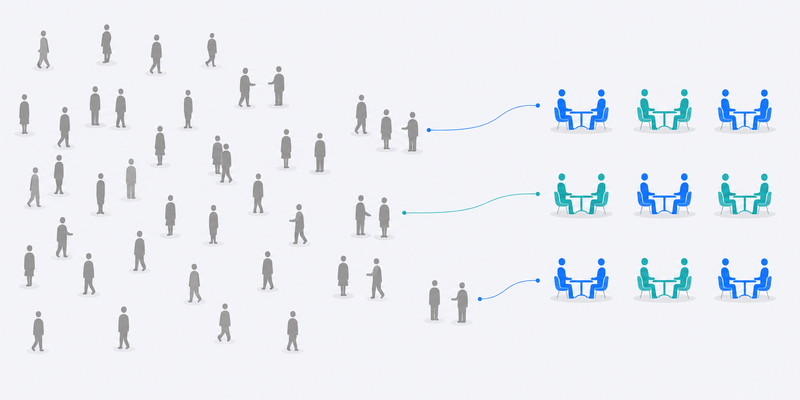
Event matchmaking software identifies which participants should meet based on structured profile data — role, industry, what they offer, what they need — then produces and manages the meetings: time slots, table assignments, rotations, reminders, mutual-interest confirmation, and follow-up.
Three adjacent tools get confused with it. An event app runs the agenda, map, and notifications, with networking bolted on as chat. A networking app lets attendees browse and message each other, then leaves the meeting to chance. A membership CRM holds the permanent record of who your members are and who they've already met — it powers matching year-round but isn't built to run a timed room. We covered that permanent layer in our guide to AI matchmaking software.
Event matchmaking software is the only one of the four that produces a schedule. Most organizers eventually need two: a CRM for the community, an engine for the events.
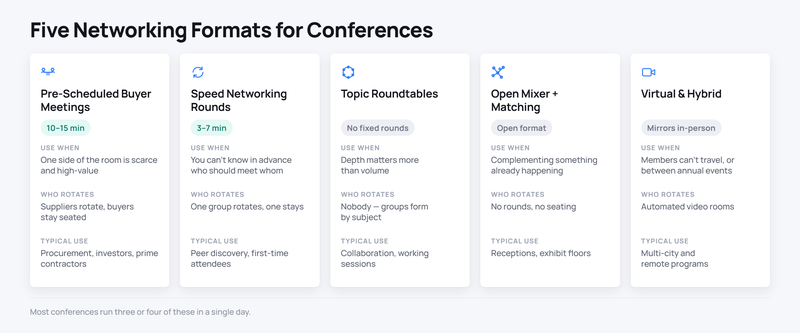
How to Run Business Matchmaking at a Conference: Five Formats
Most buying advice treats matchmaking as one thing. Real conferences — and trade shows, expos, and association annual meetings — run several formats in a day, each solving a different problem. Picking the wrong one is the most common reason a networking program underperforms on capable software.
- Pre-scheduled buyer meetings (hosted buyer programs). A fixed roster of buyers stays seated; qualified suppliers rotate through pre-booked slots assigned in advance from application data. Use when one side of the room is scarce and high-value — procurement officers, government contracting representatives, investors, prime contractors. Ten to fifteen minutes per meeting. This is the format trade shows use to give exhibitors qualified meetings instead of booth traffic.
- Speed networking rounds. Timed rotations of three to seven minutes, with a break for participants to record who they want to follow up with. Use for peer discovery inside a membership base, or any audience where you can't know in advance who should meet whom. The complete guide to hosting successful networking events covers the room logistics.
- Topic roundtables. Small groups form around a subject rather than a pairing. Use for depth over volume.
- Open mixers with a matching layer. No rounds, no seating. Attendees see a compatibility-filtered list of who's in the room and approach whoever matters to them. Use as a complement to something already happening — a reception, an exhibit floor — where a rigid rotation would intrude.
- Virtual and hybrid formats. The same patterns in automated video rooms. Use for members who can't travel, and to keep momentum between annual events.
A well-designed conference uses three or four of these in one day. The 2026 Latina BIZCON™ program lists BizMatch and Speed Networking as separate tracks alongside a B2B roundtable session, exhibitor tables, and a VIP closing reception — four connection mechanics serving four goals.
Five Things a General Event Platform Gets Wrong
Five operational details are where general event platforms fall down. Rotation logic decides which group stays seated and which moves — mentors stay, mentees rotate; buyers stay, suppliers rotate. Mutual-interest reveal lets participants privately record who they want to meet, exchanging contact details only when interest is mutual, which is what makes the format socially safe.
Real-time schedule visibility lets staff fill gaps during the event instead of after it. Automation lets one coordinator run many events rather than one. And registration integration is the difference between a synced list and someone reconciling two spreadsheets the night before.

Case Study: NLBWA-IE and Latina BizCon
The National Latina Business Women Association – Inland Empire Institute runs Latina BIZCON™, an annual Southern California conference connecting Latina-owned small businesses with corporate, government, and utility buyers. It's a useful case precisely because it isn't an enterprise event operation — it ran for its first five years on a single staff member.
The problem: a ceiling set by headcount
Executive Director Maria Solano matched on paper: a list of vendors and what they did, a list of buyers and what they were purchasing, paired by hand. It worked — it just didn't scale. In her interview with SmartMatchApp, Solano put the ceiling plainly: on her own, she could handle roughly 20 vendors matched to four buyers per conference, and no more.
The fix: a schedule you can see while the event is running
The first year on a business matchmaking platform produced 45 appointments across 8 buyers and 30 vendors. The following year roughly doubled again — close to 100 appointments, 14 buyers, 50 vendors.
The detail that gets overlooked is what happened on the day. Around 20 unregistered vendors walked in, and because the schedule was visible in real time, staff could see exactly where the gaps were. Solano's account:
"At the Latina BizCon 2022, we were able to identify matches, see the schedule, find the gaps, plug them in, and book appointments efficiently, all thanks to the business matchmaking technology. Even the 20 unregistered 'walk-ins' were easily matched, producing another 30 highly precise appointments."
That's roughly 30 additional meetings a paper process would simply have turned away.

Why it mattered at scale
The conference grew from 70 attendees at its 2017 launch to roughly 250, and the buyer side grew with it. The procurement matchmaking program launched with partners including Southern California Edison, SoCal Gas, the Metropolitan Water District, the California Department of General Services, Kaiser Permanente and Wells Fargo. The 2026 program now describes BIZMATCH™ as pre-scheduled 10-minute sessions with corporate, government, utility, and prime contractor representatives — the format formalized and named.
The strategic shift matters more than the numbers. Contracting opportunities come up throughout the year, not on the last Thursday in October. Because member and buyer profiles live in a permanent database rather than a conference spreadsheet, matching continues between events as new members join. The conference became the intake moment for a year-round program rather than the whole program.
NLBWA-IE evolution at a glance
|
Appointments per conference |
~20 manual → 45 → ~100 |
|
Buyers |
4 → 8 → 14 |
|
Walk-ins matched on the day |
~20 vendors, ~30 additional appointments |
|
Conference attendance |
70 (2017) → ~250 |
|
Program totals |
485 attendees, 300+ jobs, $24M in contracts |
|
Matching cadence |
Year-round, not conference-week only |
The full story is in how a thriving network of Latina entrepreneurs uses a business matchmaking platform.
A Different Angle: SHE Talks and Small, Frequent Events
The annual flagship is the obvious use case. It's also the least efficient one, because it concentrates a community's entire connection value into a single day.
Lead and Empower Her SHE Talks runs its speed matching sessions on a recurring schedule instead. We covered how the community uses year-round member matching elsewhere; the event side is a separate lesson. Sessions run on the organization's own branded event subdomain, ticketed at $20 and open to non-members as well as members — making each one both a retention touchpoint and an acquisition channel.
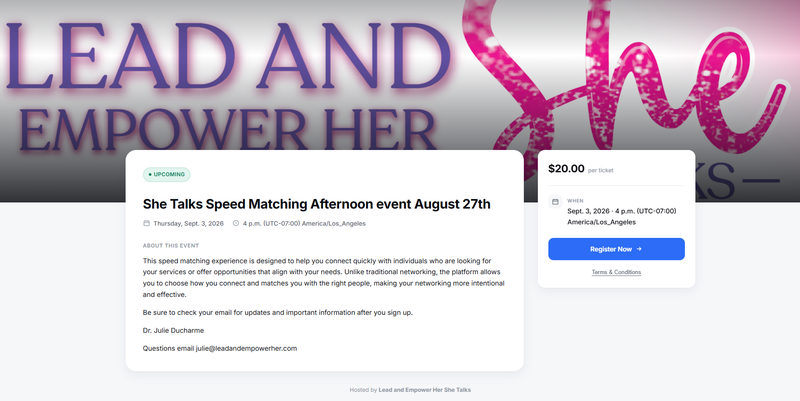
The economics differ from a conference. Once the format is built, a recurring session has near-zero marginal setup cost, generates its own revenue, and gives members a reason to stay subscribed in the months with no flagship event. For most member organizations, this cadence produces more total connections per year than the annual conference does, at a fraction of the operational load.
For associations weighing both: the conference fills the database, and the recurring sessions keep it warm.
Why the CRM and the Event Engine Are Different Jobs
This distinction decides your stack, and most buying guides skip it.
A matchmaking CRM is the permanent layer — member profiles, matching criteria, introduction history, membership status. It answers who is in this community and who have they already met. Its value compounds over years.
An event matchmaking engine is the session layer — rotations, timed rounds, table assignments, check-in, mutual selections, video rooms, match delivery. It answers what happens in this room for the next ninety minutes.
Running timed rotations out of a CRM produces a bad event. Running a year-round community out of an event tool means starting from zero every time — profiles rebuilt for each session, connections lost once the conference ends. The practical answer is both, synced, so event participants become community records automatically and community records prefill event profiles. NLBWA-IE's member portal and SHE Talks' event subdomain are two halves of the same pattern.

What to Look For When Evaluating Event Matchmaking Software
Most platforms in this category describe themselves in nearly identical terms. The differences show up in four places — worth asking on any demo call, whichever vendor you're evaluating.
What does the matchmaking capability cost, not the platform? Most of this category won't tell you. Cvent publishes no pricing at all, and most matchmaking-first vendors quote per event after a discovery call. Bizzabo is a rare exception at $499 per user per month with a three-user minimum — but networking and matchmaking sit outside the base subscription, on the add-on menu with SSO and API access. The published floor buys the platform, not the capability. Ask for both numbers, before the demo.
Does it fit the size of event you actually run? The category splits by event scale, and the split is sharper than the marketing suggests. Enterprise matchmaking engines — Brella, Grip, Swapcard, ExpoPlatform, Cvent — are built for trade shows with thousands of attendees, exhibitor hierarchies, and sponsor inventory to protect, and they're priced accordingly. Mid-market platforms like b2match, Eventdex, and Whova serve conferences in the hundreds to low thousands. Dedicated speed networking and event matchmaking tools sit below that again — SpeedMatchApp publishes its tiers at $100, $150, and $200 per month. A 250-person association conference evaluated against enterprise pricing usually concludes structured matchmaking is out of reach. It isn't; the organization was just looking at the wrong tier.
Can it run more than one format? A tool that only does timed rotations can't handle your hosted-buyer program, and one that only does pre-scheduled meetings can't run your reception. Ask which of the five formats above it supports natively.
Can you measure whether it worked? Four numbers make events comparable year over year: match acceptance rate (below 40% usually means your profile fields are too thin), meetings per attendee (two is a reasonable floor), kept-meeting rate (aim above 80% — lower is a logistics problem, not a matching problem), and second-meeting conversion, the number sponsors and boards actually care about. If a platform can't report three of these without a manual export, it won't help you prove the program works.
FAQs
What is event matchmaking software? Event matchmaking software pairs conference attendees for one-to-one meetings based on their profiles, goals, and availability, then schedules and manages those meetings — assigning time slots and tables, running rotations, confirming mutual interest, and reporting which meetings took place. It differs from a networking app, which supports browsing and messaging but leaves the meeting to the attendees.
How do you run business matchmaking at a conference? Collect structured profiles at registration — what each participant offers and what they're looking for — then qualify participants into groups (buyers and suppliers, mentors and mentees), let the software generate and schedule the pairings into timed slots at numbered tables, and confirm meetings by email in advance. On the day, keep the schedule visible so staff can fill gaps and handle walk-ins. Afterwards, send matches and capture whether meetings happened.
What does event matchmaking software cost? Pricing splits by event scale. Enterprise platforms built for large trade shows are quoted per event and commonly run into five figures; Cvent publishes no pricing at all. Bizzabo publishes $499 per user per month with a three-user minimum, though networking and matchmaking sit outside that base subscription. Dedicated speed networking and event matchmaking tools are priced in the low hundreds per month — SpeedMatchApp publishes tiers at $100, $150, and $200. Always ask what the matchmaking capability costs separately from the platform.
What's the difference between speed networking and business matchmaking? Speed networking rotates everyone through short timed meetings without pre-selecting the pairs. Business matchmaking pre-schedules specific meetings between two defined groups — typically buyers and suppliers — based on applications and qualification criteria. Speed networking is for discovery across a peer group; business matchmaking allocates access to a scarce, high-value group.
How long should a speed networking round be? Three to seven minutes per conversation, plus a short break between rounds for participants to record who they want to connect with. Procurement and hosted-buyer meetings run longer, typically 10 to 15 minutes, because participants are presenting capabilities rather than making introductions. There's a fuller breakdown in this guide to running speed networking events.
The Bottom Line
Conferences are expensive, infrequent, and judged on whether people leave with something. The organizations that get the most from them aren't the ones with the biggest platforms — they're the ones that pick the right format for each objective, run it on a system built for that format, and keep the resulting relationships somewhere that survives until next year.
SpeedMatchApp handles the event layer — speed networking, business matchmaking, and mixer formats, in person and on video, with over 3,500 events run to date. SmartMatchApp handles the permanent one. The two sync.
👉 Book a demo to see how they work together for your next event.
