News • August 21, 2026
How Dating Agencies Use Matchmaking Software to Scale Personal Introductions (2026)
Dating agency revenue is rising while the number of agencies falls. See how two agencies restructured matching to carry more clients per matchmaker.
By Kair Mourtazov, SmartMatchApp Product Specialist
Reading time: ~9 minutes
TL;DR
The number of US dating services businesses has fallen 3.7% a year since 2020, to around 380, per IBISWorld — while the two largest dating app companies shed paying users and their most intent-driven products grew. Fewer operators, demand moving toward intent. What decides whether an agency can absorb it is not database size but how many matchmaker hours each client consumes, and most of those hours go to search, coordination, feedback and reassurance rather than to judgment. This guide covers where the time goes and how two agencies — B-Loved in the Netherlands and Belgium, and Maclynn internationally — rebuilt their operations to carry more clients per matchmaker without lowering the standard of the introduction.
Why There Are Fewer Dating Agencies Every Year
Start with the number that is hardest to argue with. IBISWorld's December 2025 analysis of US Dating Services counts around 380 businesses in the category, a figure falling 3.7% a year since 2020. Revenue over the same period grew 8.1% a year, to $3.2 billion — though that category folds online dating in with matchmakers and singles events, and Match Group sits inside it, so treat the revenue line as mixed. The count of firms is harder to distort — Match Group is only one business, however large. On that measure, operators are steadily leaving the category.
However, demand is not leaving with them. Match Group's second-quarter 2026 results put total payers down 6% to 13.3 million, with revenue per payer up 6%. Tinder payers fell 5% and monthly active users 7%. Hinge went the other way: revenue up 22%, monthly active users up 13%, payers up 17%. Bumble's second quarter showed paying users down 16.4% to 3.16 million with revenue down 15.2%.
Both companies are holding revenue by charging a shrinking base more. The one product growing across either portfolio is the one built around stated intent rather than volume.
So: fewer operators, and demand moving toward intent. Which raises the question this article is about — if you are one of the 380, what decides whether you can take on a higher share of the market?
Alissa Sherman runs Matched by Ali, a boutique high-end practice serving successful singles in the US and Canada. Her diagnosis of what brings people in is not scarcity.
"The crisis is not about a lack of single people. It's a psychological crisis that these singles are facing." — Alissa Sherman, Founder, Matched by Ali
Her clients already outsource expertise everywhere else — legal, financial, physical training — and treat matchmaking as the same purchase applied to a decision they rate above all of them. She draws one distinction that explains the price: an algorithm optimises for the first date, while she is trying to optimise for the last one.
That is the product, and it is expensive to deliver.
Where a Matchmaker's Time Actually Goes
Ask agency owners which part of the work consumes the day and the answer is search. B-Loved's Maya Schaareman put the trade-off plainly: a matchmaker can work a hundred-hour week to find one excellent match for a client who cannot reasonably be charged for a hundred hours. Asked directly whether profile preparation or search takes longer, her partner Vanessa Pilloni did not hesitate on search.
Three further demands sit alongside it:
- Coordination. Scheduling, availability, rescheduling, and the admin behind every introduction.
- Feedback. Speaking to both sides after a date — where a good agency earns its outcomes, and where a bad one loses couples who both liked each other and each assumed the other did not.
- Reassurance. Between introductions, clients cannot see the work being done for them, so they conclude none is.
Schaareman named reassurance as B-Loved's central problem before anything else. Clients lose belief in the process during the gap, and a matchmaker cannot fix it by explaining, because the work does not lend itself to being shown.
Together these set a hard ceiling: matchmaker hours divided by hours per client. Growing without changing that ratio means hiring, which is why the number of agencies falls while revenue rises. Scale in this industry has meant headcount, and headcount is hard.
The job of AI matchmaking software here is narrower than it is often sold as. It is not only to make the match. A 2025 study from ELLIS Alicante and the Max Planck Institute for Software Systems tested a system that makes only the matching decisions it is most confident about and defers the rest to a person. Across 800 participants completing 80,000 matching decisions, the split outcome beat both the algorithm alone and the human alone. The task was assigning patients to appointment slots rather than people to each other, but the transferable finding is about where the split falls: the stronger the human decision-maker, the more decisions were worth handing to them. For the best-performing participants, the optimal move was to defer all of them.
Which is the argument for taking coordination, feedback capture and reassurance off a matchmaker's desk, and leaving the judgment where it is. The two agencies below did that in opposite ways.
Case Study: How B-Loved Brings Clients Into the Search
B-Loved serves higher-educated and entrepreneurial singles across the Netherlands and Belgium from Eindhoven. Partners Maya Schaareman and Vanessa Pilloni built it as a deliberate contrast to Schaareman's other agency, Date for 2, which remains a premium hands-off service. B-Loved noticed results after implementing SmartMatchApp.
The Problem: The Silence Between Introductions
The founding constraint was not match quality. It was the wait. A first introduction might come weeks after intake, the second weeks after that, and in between nothing appeared to be happening. A matchmaker with a large database cannot give every client the ongoing attention that would correct the impression.
B-Loved tried the standard answers — a blog, a mailing list, online sessions. Schaareman's assessment was blunt: some clients do not want to be educated, they just want to meet someone.
The Build: Client Participation Inside a Screened Database
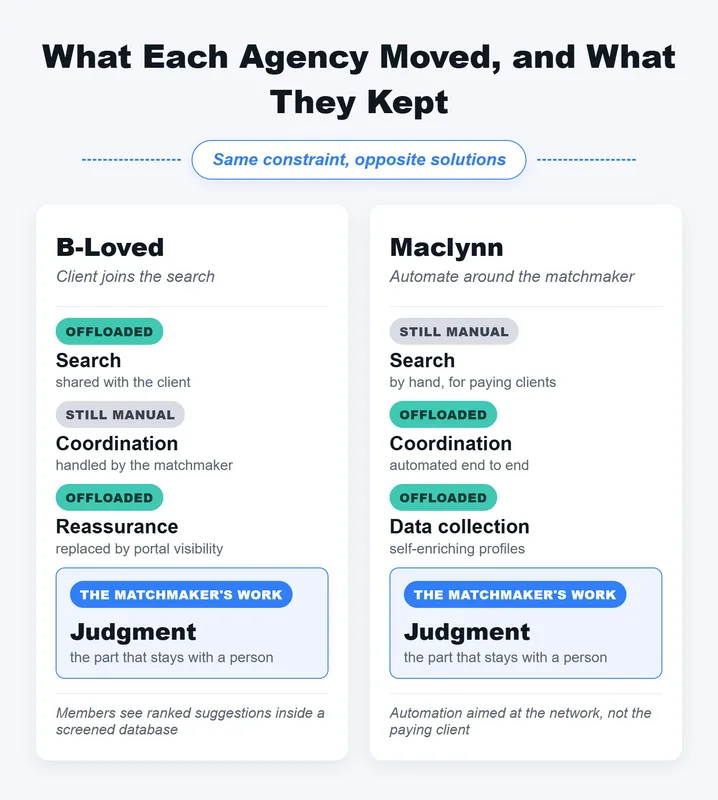
The fix inverted the model. Instead of the matchmaker searching for the client, the client searches alongside the matchmaker, inside a database where every profile has already been vetted.
Three design choices make that safe:
- Client-built profiles, agency-screened. Members create and maintain their own profiles through the portal, but screening did not move. Submissions are held for review rather than entering the active database on submit, and every new member sits an intake interview with Pilloni before being admitted.
- Capped suggestions. Rather than an open directory, each member sees a small ranked set: three suggestions on the lower tier, five on the higher one. Volume is constrained on purpose.
- Anonymity by default. Suggestions carry no photograph, no name, no city. Members judge the profile, then send a connection request that resolves identity only on mutual approval.
Hand-made introductions from Schaareman and Pilloni continue in parallel, and every member reaction notifies the matchmaker, who can step in.
What Changed
The effect Schaareman reports is not more matches. It is that the reassurance problem stopped costing time.
Her clearest example: clients convinced nothing had happened in months, whose last match had been three days earlier. Once members can see their own match history in the portal, that conversation does not need to happen. The perception gap closes without a matchmaker closing it.
She also reports a lighter load for Pilloni. Presenting a match by hand meant writing it up, sending it, and handling the reply, over and over. Moving the routine layer into the portal reserved hand-made introductions for the matches that warranted them.
Schaareman describes the whole exercise as synergy between human judgment and algorithm, and is candid that the hardest part was not the technology but persuading experienced matchmakers to change how they worked.
Since the Interview
The model has matured. B-Loved now runs three matchmakers, with Pilloni as lead handling intake and client communication and Schaareman covering international and high-end matching alongside the back office. Prospective members start with a free, no-obligation video call. The member portal is live, and the published tiers have consolidated around a Gold Membership.
The participation layer was not a phase on the way to something else. It became the product.
B-Loved at a Glance
| Organisation | B-Loved: personal matchmaking for the Netherlands and Belgium |
|---|---|
| Partners | Maya Schaareman, Vanessa Pilloni |
| Base | Eindhoven |
| Clients | Higher-educated, entrepreneurial singles seeking long-term relationships |
| Model | Hybrid — hand-made introductions plus client-facing ranked suggestions |
| Suggestions per member | Capped by tier: three on the lower, five on the higher |
| Privacy | Anonymous profiles; no photo, name or city until mutual connection |
| Screening | Intake interview with a matchmaker for every member, self-registered included |
| Team now | Three matchmakers |
| Platform | SmartMatchApp member portal |

The longer version of how the model came together: Revolutionizing Love: How B-Loved's Hybrid Matchmaking Blends Technology with Human Touch.
Case Study: How Maclynn Automates Around Its Matchmakers
Maclynn, formerly The Vida Consultancy, is an international matchmaking firm founded in 2011 by Rachel Vida MacLynn, a chartered psychologist. It runs offices in London, Dubai, New York, Los Angeles, San Francisco and Morristown, New Jersey, and searches globally for clients as far as Australia. Global Operations Director Mia Wealthall puts the team at around 25 people. Maclynn has run on SmartMatchApp since 2017, rolling out in the US first and migrating the rest of the world shortly after.
The Problem: Two Populations, One Team
Maclynn runs two distinct populations against each other.
On one side, paying clients receive a bespoke service built on a five-step methodology: understanding themselves, defining the ideal match, visualising the relationship and its timelines, building and executing a search plan, and dating with intent. The expertise concentrates in step two. Clients arrive with a checklist, and the matchmaker's job is to find the gap between what they think they want and what would actually work — a client who says they want someone successful usually means someone driven, and those are different searches.
On the other side is the network the matches come from: around 25,000 open members globally, plus reach into far larger pools through agency collaborations, partnerships, and an ambassador programme of 150 connectors across cosmopolitan cities.
The paying side does not lend itself to automation. The other side largely has to be automated, or it absorbs the matchmakers who should be serving the paying side.
The Build: Automation Aimed at the Right Population
The split is explicit. Data gathering for paying clients happens in person or by phone. Data gathering for the open-member network runs on automation.
By Wealthall's count the agency runs around 24 automations firing roughly 85 triggers a day. The most substantial is a 28-day onboarding sequence for new database members, which does something more useful than sending welcome emails — it collects matching data. An attachment-style questionnaire goes out through Typeform, the member completes it, and the results flow back into the platform to sit on the profile where a matchmaker can act on them. The same pattern runs for dating values and current dating situation.
Profiles, in effect, enrich themselves. A matchmaker opening a member record months later finds structured, matchable data that nobody on the team spent an hour collecting.
Around that sits the operational layer: advanced and saved searches, reporting used for management and admin, a ticketing system routing tasks to assistants across time zones, templated email, and match notes that write to both profiles at once.
Wealthall's summary is the sharpest statement of the capacity argument I have heard from an operator:
"A matchmaker can only work as quickly and as effectively or efficiently as their CRM." — Mia Wealthall, Global Operations Director, Maclynn
The Feedback Loop Is the Product
The step Maclynn treats as non-negotiable is the one most easily cut: post-date feedback from both parties.
A meaningful share of Maclynn's successful couples would not exist without it. Two people leave a date each convinced the other was not interested; the matchmaker speaks to both, discovers otherwise, and there is a second date. No algorithm recovers that on its own, because the signal never enters the system unless someone asks for it.
The loop compounds. Each round of feedback sharpens the search, which is why Maclynn sees more successful matches later in a membership than at the start — an argument for recording outcomes per introduction rather than per client.
Wealthall is measured on where AI takes the industry. She expects it to improve online dating: better profiles, better photos, better messages. Her concern is that better-presented profiles become harder to read, because the effort signal that currently helps people self-select disappears. Her example is a word like "adventurous," which means skydiving to one person and a new restaurant each week to another. Both accurate, neither compatible. Resolving that ambiguity is what a matchmaker does.
Maclynn at a Glance
| Organisation | Maclynn (formerly The Vida Consultancy): psychology-led international matchmaking |
|---|---|
| Founder & CEO | Rachel Vida MacLynn, chartered psychologist |
| Global Operations Director | Mia Wealthall |
| Founded | 2011 (as Vida Consultancy) |
| Offices | London (HQ), Dubai, New York, Los Angeles, San Francisco, Morristown NJ |
| Team | Around 25 globally |
| Network | ~25,000 open members, plus 150 ambassadors, collaborations and partnerships |
| Methodology | Five steps: know yourself, define the match, visualise the relationship, plan and execute, date with intent |
| Automation | ~24 automations, ~85 triggers a day |
| Onboarding | 28-day sequence collecting attachment style, dating values and current dating situation into the profile |
| Platform | SmartMatchApp since 2017 (US first, rest of world following) |

Manual Matching vs. Matchmaking Software
| Manual | Matchmaking software | |
|---|---|---|
| Finding candidates | Matchmaker's memory, notes and inbox | Structured profiles, filtered and ranked against stated criteria |
| Capacity ceiling | Hours per client × matchmakers | Data quality and screening throughput |
| Profile data | Collected by the matchmaker, one conversation at a time | Collected once, enriched automatically, structured for matching |
| Introductions | Written, sent and chased individually | Templated with the reason for the match, sent and tracked |
| Client visibility | Nothing between introductions | Member sees their own match history and status |
| Date feedback | Captured if someone remembers to ask | Prompted after each introduction, recorded against both profiles |
| Learning | Lives in the matchmaker's head | Recorded per match, informing the next search |
| Key-person risk | The network leaves when the matchmaker does | The network stays in the system |
Client visibility is the row that matters most for a dating agency. In other verticals it is a convenience. Here it tends to be the difference between a client who renews and one who quietly concludes nothing is happening.
The underlying constraint is not unique to dating, though. It shows up wherever introductions are made by hand — in professional associations trying to deliver peer value at scale, in conference programmes turning attendance into meetings, in mentorship programs pairing mentors with mentees, and in business networks turning introductions into deals. What differs is the stakes attached to getting a single introduction wrong.
What to Look For in Dating Agency Matchmaking Software
Four questions separate platforms that describe themselves identically.
Can screening survive self-service? A client-facing portal is only an asset if entering the database still requires a human decision. Look for a workflow where members build and maintain their own profiles while intake approval stays with the agency. Without that separation, what you have is closer to a dating site than a matchmaking service. Our walkthrough on setting up a matchmaking database covers how fields, client types and submission forms fit together.
Can you control what a member sees, and how much? Capped suggestion counts, anonymised fields, tier-based access and gated contact are what keep a member portal inside a matchmaking service. All-or-nothing visibility will not fit a discreet practice. How the ranking behind those suggestions is weighted is a separate decision, covered in our guide to setting up AI matching criteria.
Does profile data collect itself? The highest-leverage automation is not the introduction email. It is the intake sequence that gathers matchable data from a non-paying network and writes it to the profile. Check whether external forms can feed structured fields, not just attachments.
Is feedback captured per introduction? Post-date feedback from both sides is where match quality compounds. It should be prompted automatically and recorded against the pair, rather than left as a note someone has to remember to write. Our guide to introductions, presets and match automation covers how that loop is wired up in practice.
Dating Agency Matchmaking Software FAQs
What is dating agency matchmaking software? Dating agency matchmaking software is a purpose-built CRM for professional matchmakers that stores screened member profiles as structured, matchable data, ranks candidates against stated preferences, sends and tracks introductions, and records post-date feedback against both profiles. It differs from a general CRM in being built around a two-sided introduction rather than a one-directional sales pipeline.
How is a matchmaking agency different from a dating app? A matchmaking agency screens every member, runs an in-depth intake to establish what a client needs rather than what they list, selects a small number of introductions by hand, and gathers feedback after each date to refine the next search. A dating app presents self-reported profiles at volume and leaves selection, vetting and follow-up to the user.
Can clients browse other members without it becoming a dating site? Yes, if visibility is controlled. Agencies cap how many suggestions a member sees, strip identifying details such as photographs and names until both sides approve a connection, and keep intake approval with a matchmaker. B-Loved runs exactly this configuration alongside hand-made introductions.
What should a matchmaker automate first? Data collection for the non-paying side of the database. Onboarding sequences that gather structured matching data from network members give the most leverage, because they enrich profiles without consuming matchmaker hours. Introduction templates and feedback prompts come next.
How many clients can one matchmaker handle? A matchmaker's capacity is better measured in hours per client than in clients per matchmaker, because the ceiling moves depending on how much non-matching work has been taken off their desk. Reduce the time spent on search support, coordination and reassurance, and the number of clients rises without the standard of the introduction falling.
The Bottom Line
The agencies still standing, and taking on more, are not matching better than everyone else. They changed what a matchmaker spends the day doing.
B-Loved moved part of the search to the client and made progress visible, which removed the reassurance burden. Maclynn automated the network side of its database so its matchmakers could stay on the client side. Different problems, opposite solutions, one underlying move: protect the hours only a person can spend.
The judgment is the product. Most of the rest is overhead — and overhead is what software is there to absorb.
👉 See how SmartMatchApp supports dating and marriage agencies, or book a demo to walk through your agency's setup.
